My interests span multilingual and multimodal AI, reasoning, and intelligent agents. What connects these areas is a broader ambition: to build intelligent, efficient, and interactive AI systems that work alongside people, help push the frontiers of scientific discovery, and make everyday life better. I enjoy turning ideas into working code—building, testing, and refining systems until they do something useful. It is an exciting time to work in AI, and I am eager to contribute to what comes next.
Research interests: Multilingual & Multimodal AI · LLM Reasoning · Interactive Agents · Efficient AI
News
Oct 2026Serving as an Industry Track Co-Chair for the 2026 Conference on Empirical Methods in Natural Language Processing (EMNLP 2026).
Aug 2026GTS accepted to the 2026 Conference on Empirical Methods in Natural Language Processing (EMNLP 2026).
June 2026Serving as a Teaching Assistant for FIT5217 at Monash University.
Apr 2026Towards Inference-time Scaling for Continuous Space Reasoning accepted to Findings of ACL 2026.
Selected Publications
GTS: Inference-Time Scaling of Latent Reasoning with a Learnable Gaussian Thought Sampler
Minghan Wang, Ye Bai, Thuy-Trang Vu, Ehsan Shareghi, Gholamreza Haffari
Proceedings of the 2026 Conference on Empirical Methods in Natural Language Processing (EMNLP 2026)
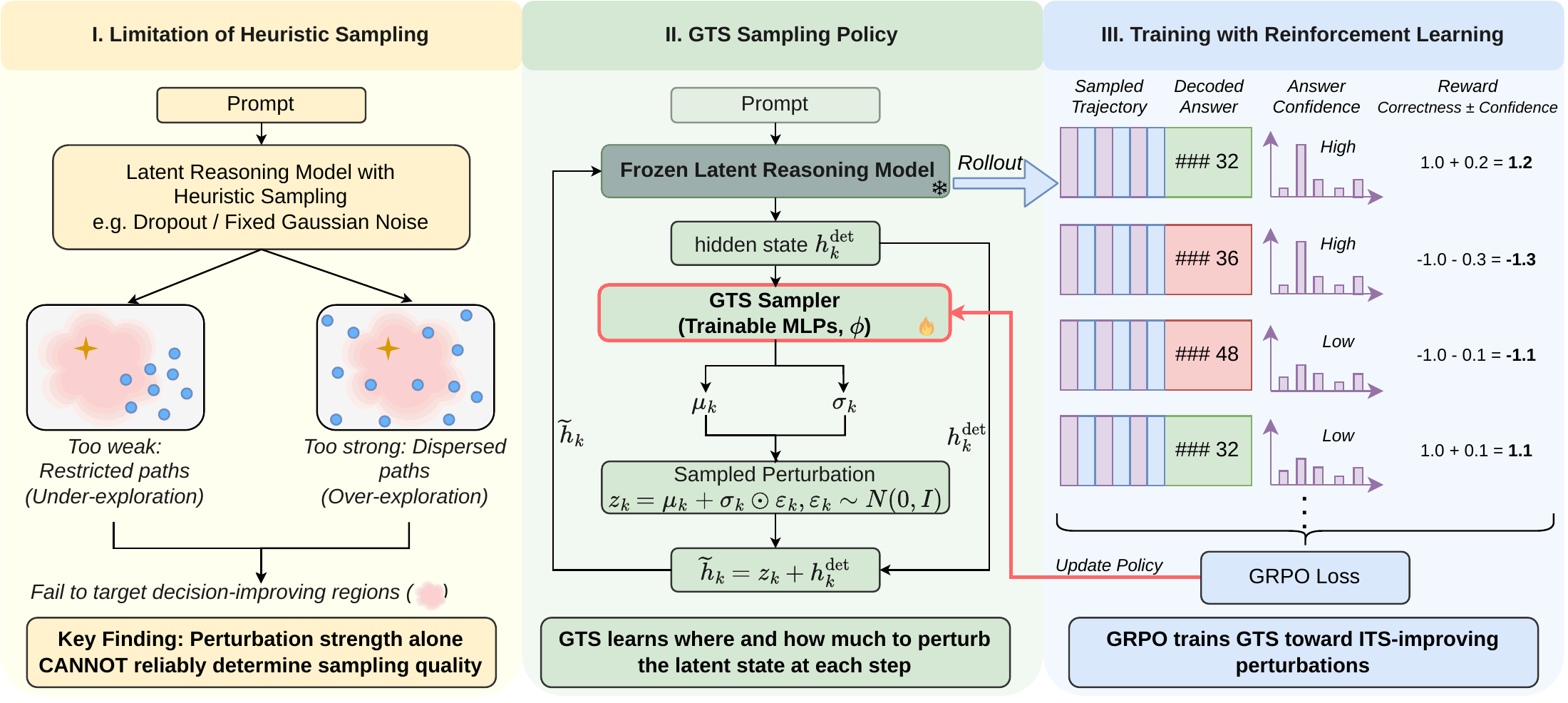
TL;DR A learnable, context-conditioned Gaussian sampler makes latent reasoning trajectories more useful at inference time, improving pass@N without updating the reasoning backbone.
Inference-time scaling (ITS) for latent reasoning requires sampling multiple candidate latent trajectories, yet current methods typically rely on heuristic perturbations such as dropout or fixed Gaussian noise. We show that stronger perturbations do not necessarily improve candidate-set quality: they often induce larger distribution shifts without producing more decision-useful reasoning paths. This limitation arises because heuristic perturbations inject stochasticity through fixed or hand-designed mechanisms rather than an optimizable, context-conditioned sampling policy, making latent exploration difficult to control. We focus on the sampling side of latent ITS and propose the Gaussian Thought Sampler (GTS), a lightweight module that predicts context-dependent Gaussian perturbations over continuous reasoning states. Trained with GRPO-style policy optimization while keeping the backbone frozen, GTS turns heuristic perturbation into a trainable, context-conditioned sampling policy. Experiments across two latent reasoning backbones and multiple benchmarks show that GTS consistently improves pass@N over heuristic baselines, suggesting that effective sampling for latent ITS requires controlled, optimizable exploration rather than simply amplified stochasticity.
Towards Inference-time Scaling for Continuous Space Reasoning
Findings of the Association for Computational Linguistics: ACL 2026 (64th Annual Meeting of the Association for Computational Linguistics)
TL;DR Investigates how test-time sampling and verification transfer from textual chain-of-thought to continuous latent reasoning, revealing the limitations of conventional rerankers.
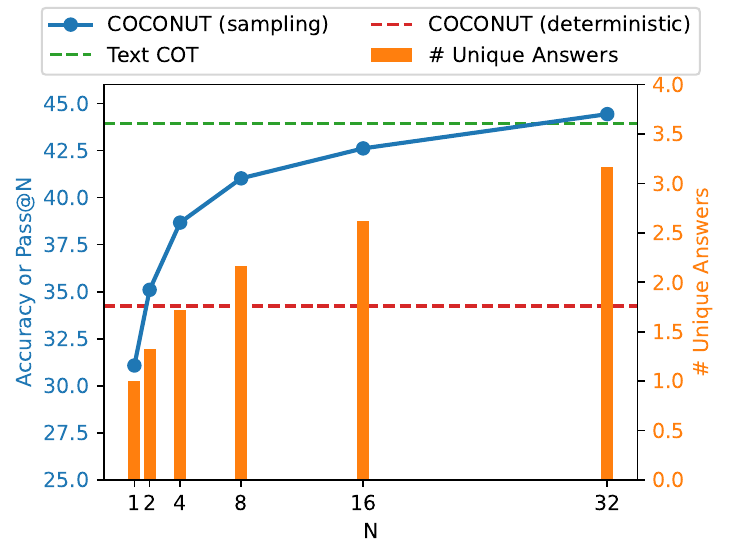
Inference-time scaling through multiple sample generation in combination with Process- or Outcome-Reward Model (PRM or ORM) re-ranking has proven effective for text-based reasoning in large language models. This paper investigates whether such established techniques can be successfully adapted to reasoning in the continuous space, using COCONUT (CITATION) continuous space reasoning LM as the backbone. We demonstrate the feasibility of generating diverse reasoning paths through dropout-based sampling. Our Pass@N analysis on the generated samples reveals the potential that could enable a significant gain in performance akin to gains observed in the discrete space. However, we highlight unique challenges faced for materializing this gain in the continuous thought space. In particular, working recipes for data generation and training PRM and ORM models in the discrete space unlocks only marginal improvements in the continuous space. Through probing various aspects including geometric properties and trajectory dynamics, we identify the underlying reasons that prevent effective discrimination between correct and incorrect reasoning (essential for the functioning of PRM and ORM). Our findings reveal that current limitations stem from the absence of key inductive biases in continuous thought representations.
Discrete Minds in a Continuous World: Do Language Models Know Time Passes?
Minghan Wang, Ye Bai, Thuy-Trang Vu, Ehsan Shareghi, Gholamreza Haffari
Findings of the Association for Computational Linguistics: EMNLP 2025
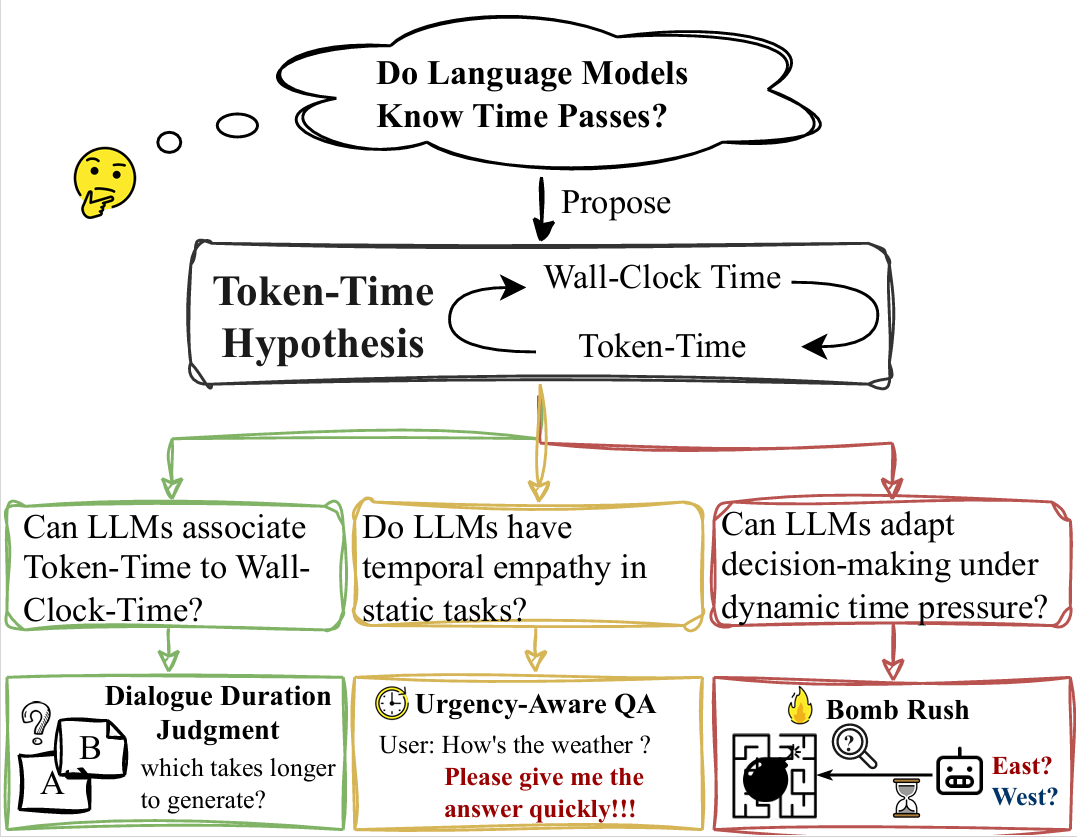
TL;DR Tests whether language models perceive elapsed time, not just reason about dates, through dialogue judgments, urgency-aware answers and an interactive time-pressure task.
While Large Language Models (LLMs) excel at temporal reasoning tasks like event ordering and duration estimation, their ability to perceive the actual passage of time remains unexplored. We investigate whether LLMs perceive the passage of time and adapt their decision-making accordingly through three complementary experiments. First, we introduce the Token-Time Hypothesis, positing that LLMs can map discrete token counts to continuous wall-clock time, and validate this through a dialogue duration judgment task. Second, we demonstrate that LLMs could use this awareness to adapt their response length while maintaining accuracy when users express urgency in question answering tasks. Finally, we develop BombRush, an interactive navigation challenge that examines how LLMs modify behavior under progressive time pressure in dynamic environments. Our findings indicate that LLMs possess certain awareness of time passage, enabling them to bridge discrete linguistic tokens and continuous physical time, though this capability varies with model size and reasoning abilities. This work establishes a theoretical foundation for enhancing temporal awareness in LLMs for time-sensitive applications.
SpeechDialogueFactory: A Framework for Natural Speech Dialogue Generation
Proceedings of the 26th Annual Conference of the International Speech Communication Association (Interspeech 2025)
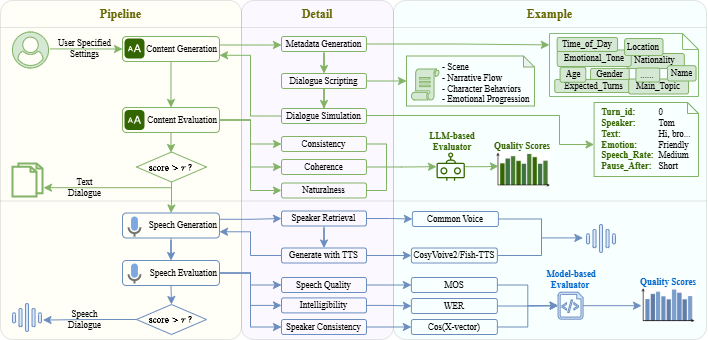
TL;DR Generates natural and controllable synthetic spoken dialogues using structured scripts, speaker voices and paralinguistic cues, with automated quality evaluation.
High-quality speech conversational datasets are essential for developing and evaluating Speech-LLMs. However, collecting real-world recordings presents significant challenges including high costs, privacy concerns, and inconsistent quality, while existing synthetic approaches often lack authenticity due to limited acoustic variety and insufficient paralinguistic information. We present SpeechDialogueFactory, a framework that addresses these limitations through a three-stage pipeline: generating comprehensive metadata, creating detailed scripts, and producing utterances enriched with paralinguistic features. Our framework retrieves speaker voices from a voice bank and leverages paralinguistic tags for expressive TTS. We also introduce an automated evaluation protocol that shows strong correlation with human assessments. Experimental results demonstrate that our synthesized dialogues achieve quality comparable to human recordings while offering greater flexibility and control.
Conversational SimulMT: Efficient Simultaneous Translation with Large Language Models
Proceedings of the 22nd International Conference on Spoken Language Translation (IWSLT 2025)
TL;DR Reframes simultaneous translation as a multi-turn conversation, reusing the LLM's KV cache to reduce inference overhead without giving up translation quality.
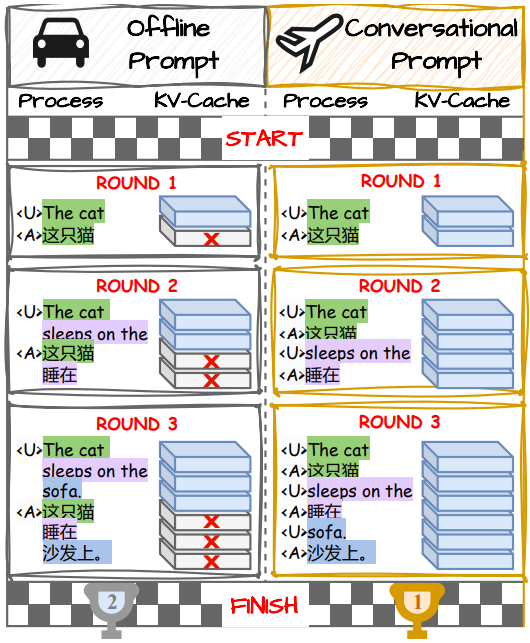
Simultaneous machine translation (SimulMT) presents a challenging trade-off between translation quality and latency. Recent studies have shown that LLMs can achieve good performance in SimulMT tasks. However, this often comes at the expense of high inference costs and latency. In this paper, we propose a conversational SimulMT framework to enhance the inference efficiency of LLM-based SimulMT through multi-turn-dialogue-based decoding where source and target chunks interleave in translation history, enabling the reuse of Key-Value cache. To adapt LLMs to the proposed conversational decoding, we create supervised fine-tuning training data by segmenting parallel sentences using an alignment tool and a novel augmentation technique to enhance generalization. Our experiments with Llama2-7b-chat on three SimulMT benchmarks demonstrate that the proposed method empowers the superiority of LLM in translation quality, meanwhile achieving comparable computational latency with specialized SimulMT models.
Simultaneous Machine Translation with Large Language Models
Proceedings of the 22nd Annual Workshop of the Australasian Language Technology Association (ALTA 2024)
TL;DR Explores whether general-purpose LLMs can handle streaming translation with a relaxed longest-common-prefix decoding strategy, balancing quality, latency and robustness.
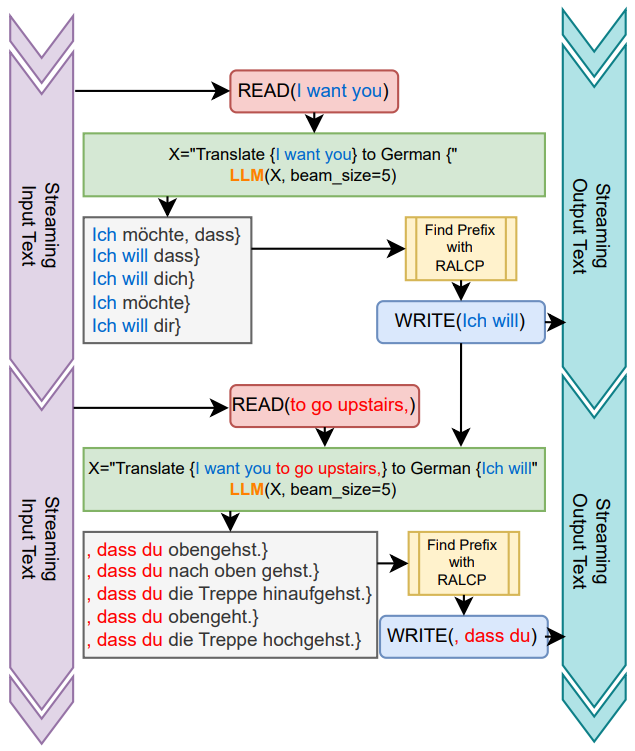
Real-world simultaneous machine translation (SimulMT) systems face more challenges than just the quality-latency trade-off. They also need to address issues related to robustness with noisy input, processing long contexts, and flexibility for knowledge injection. These challenges demand models with strong language understanding and generation capabilities which may not often equipped by dedicated MT models. In this paper, we investigate the possibility of applying Large Language Models (LLM) to SimulMT tasks by using existing incremental-decoding methods with a newly proposed RALCP algorithm for latency reduction. We conducted experiments using the Llama2-7b-chat model on nine different languages from the MUST-C dataset. The results show that LLM outperforms dedicated MT models in terms of BLEU and LAAL metrics. Further analysis indicates that LLM has advantages in terms of tuning efficiency and robustness. However, it is important to note that the computational cost of LLM remains a significant obstacle to its application in SimulMT.
Proverbs Run in Pairs: Evaluating Proverb Translation Capability of Large Language Model
Minghan Wang, Viet Thanh Pham, Farhad Moghimifar, Thuy-Trang Vu
Findings of the Association for Computational Linguistics: ACL 2025 (63rd Annual Meeting of the Association for Computational Linguistics)
TL;DR Measures how well LLMs translate culturally grounded proverbs and exposes gaps in standard automatic metrics for evaluating figurative language.
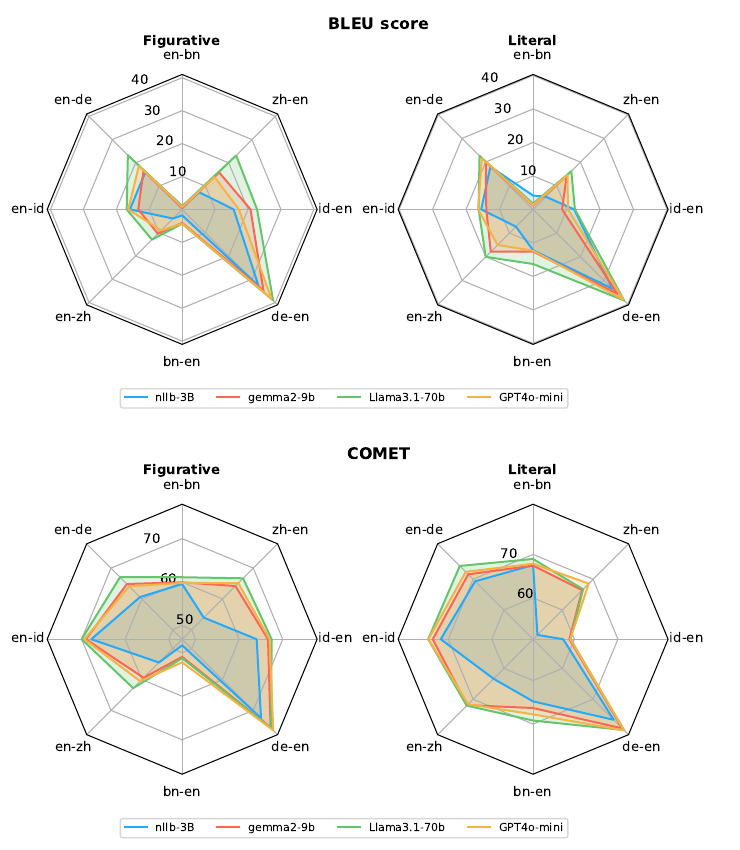
Despite achieving remarkable performance, machine translation (MT) research remains underexplored in terms of translating cultural elements in languages, such as idioms, proverbs, and colloquial expressions. This paper investigates the capability of state-of-the-art neural machine translation (NMT) and large language models (LLMs) in translating proverbs, which are deeply rooted in cultural contexts. We construct a translation dataset of standalone proverbs and proverbs in conversation for four language pairs. Our experiments show that the studied models can achieve good translation between languages with similar cultural backgrounds, and LLMs generally outperform NMT models in proverb translation. Furthermore, we find that current automatic evaluation metrics such as BLEU, CHRF++ and COMET are inadequate for reliably assessing the quality of proverb translation, highlighting the need for more culturally aware evaluation metrics.
Diformer: Directional Transformer for Neural Machine Translation
Minghan Wang, Jiaxin Guo, Yuxia Wang, Daimeng Wei, Hengchao Shang, Yinglu Li, Chang Su, Yimeng Chen, Min Zhang, Shimin Tao, Hao Yang
Proceedings of the 23rd Annual Conference of the European Association for Machine Translation (EAMT 2022)
TL;DR Unifies autoregressive and non-autoregressive translation through direction-controlled decoding while preserving the learning objectives of both paradigms.
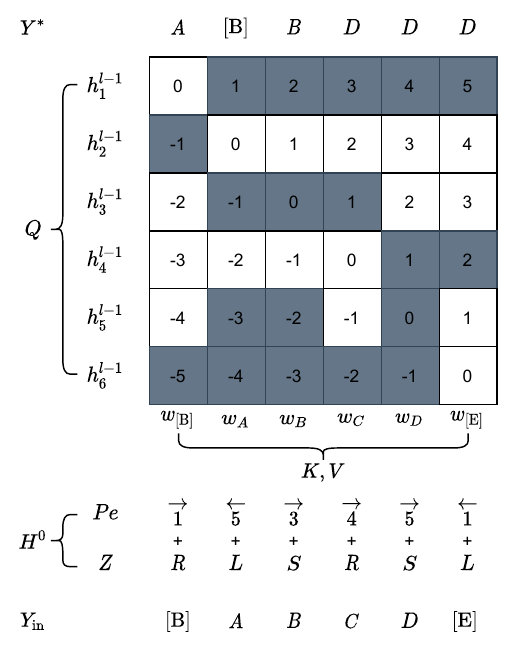
Autoregressive (AR) and Non-autoregressive (NAR) models have their own superiority on the performance and latency, combining them into one model may take advantage of both. Current combination frameworks focus more on the integration of multiple decoding paradigms with a unified generative model, e.g. Masked Language Model. However, the generalization can be harmful on the performance due to the gap between training objective and inference. In this paper, we aim to close the gap by preserving the original objective of AR and NAR under a unified framework. Specifically, we propose the Directional Transformer (Diformer) by jointly modelling AR and NAR into three generation directions (left-to-right, right-to-left and straight) with a newly introduced direction variable, which works by controlling the prediction of each token to have specific dependencies under that direction. The unification achieved by direction successfully preserves the original dependency assumption used in AR and NAR, retaining both generalization and performance. Experiments on 4 WMT benchmarks demonstrate that Diformer outperforms current united-modelling works with more than 1.5 BLEU points for both AR and NAR decoding, and is also competitive to the state-of-the-art independent AR and NAR models.